
The Attention Economy
By Sidra, Junior Editor
The phrase ‘The Attention Economy’ has been floating around the internet for the past few years. In case you haven’t heard of it yet, it essentially refers to attention being used as a form of currency that producers and big media corporations try to capture in order to keep you on their app or website for as long as possible.
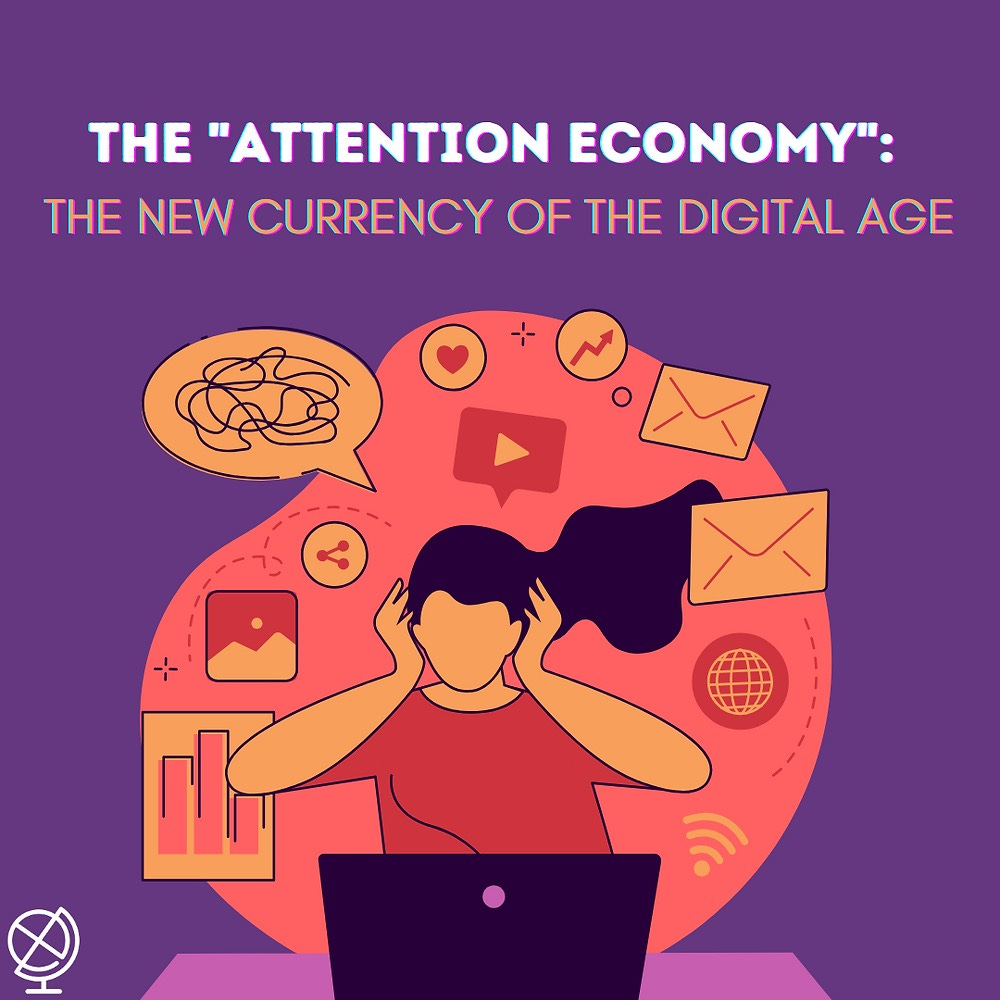
You might be asking yourself how something intangible like attention can be used as a form of currency. As it turns out, intangible objects being used as currency is nothing new, especially since the advent of NTFs and the like. Interestingly, the concept of an ‘attention economy’ is quite intuitive to an economist, so intuitive in fact, that the phrase and the phenomenon itself were coined back in 1971!
The phrase was first publicized by Herbert Simon in his speech at Princeton on ‘Designing Organizations for an Information-Rich World’, where he mentioned how information will become more and more abundant in the coming years. The scarcity-choice paradigm that we see when overpopulation depletes food stocks, that is so intrinsic to economics, may also be applied in the concept of the ‘attention economy’. When we have an excess supply of information, there must be a resource that this excess information is consumed by. In his words, an excess of information must cause a dearth in something else, and this dearth, he predicted, would be the scarcity of our attention.
The people of the 20th century would wonder whether they would ever live in an ‘information economy’. At the time, the growth of books and libraries couldn’t catch up to the growing population… However, the opposite problem has arisen; we live now in an information-abundant society, just as Simon had predicted.
Compared to the generation where content needed to be scrounged for, this era is a golden age, the internet came like the curse of Midas’s touch, turning the little information available into a vast goldmine of books, articles, and videos on every topic imaginable. The existence of public domain databases has led people to come together, whether that be solving decades-old cold cases or putting together a comprehensive compilation of financial fraud by international elites— The watershed Panama Papers are also an indirect result of our ‘information age’.
Nevertheless, an excess of anything is a vice.
With this much information, for free, what exactly are the FAANG, big media corporations, and infotech companies selling?
To paraphrase Richard Sierra, “If it is free, you are the product.” (“Television Delivers People” https://youtu.be/LvZYwaQlJsg?si=I7p0p0Xhb4CcsxV2) The traditional market setup has been flipped on its head. The propagators of mass media content are the consumers, sponsor companies and algorithms act as intermediaries, and we are the product. What is being sold is our personal information and our attention.
And of course, as is the rule of thumb, where there is competition, there is increased efficiency. The pure capitalist system rewards ambition and a hunger for growth by propelling those who show it higher and higher up in the system. In this way, companies now compete vigorously for our attention; they do this by using algorithms, more on that later.
The fatal flaw in this system is the inability to distinguish ambition from greed, and altruism from apathy. This inability to demarcate moral boundaries enables the creation of a ‘Market for Lemons’. Consumers face information asymmetry, i.e they can never be sure of the quality of the content they consume, before they consume it, especially since influencers engage in practices like ‘click-bait’. Because of this, consumers don’t have an incentive to give their full attention to any one good, and consequently, the sellers don’t have an incentive to improve their goods.
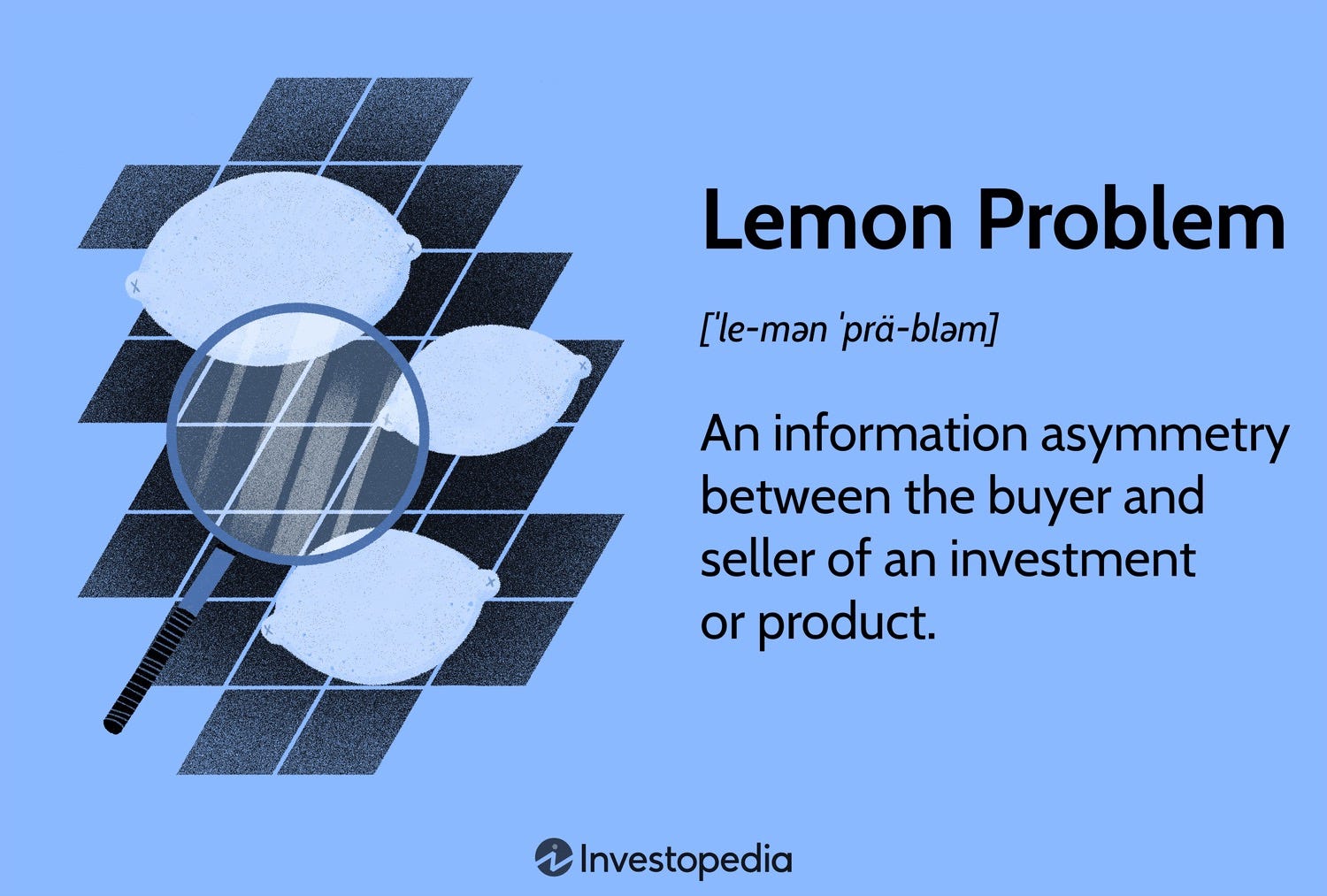
The Market for Lemons model can clearly be seen on TikTok. The platform that took the world by storm and was the modern-day pioneer for short-form content and the ‘infinite scroll’. This is because the only way to attain maximum profit is by keeping the user on the app or website for as long as possible— a motive attained by using algorithms, which TikTok has perfected.
The algorithm figures out what exactly you enjoy watching by measuring ‘retention’ and ‘engagement’ and then pushes more of that content into a curated list of videos, on the ‘For You’ Page, or FYP. A robotic algorithm doesn’t care about what is ‘good for you’, it will serve you what you enjoy watching, even if said content doesn’t have much substance. Even notifications take a second to load, which creates anticipation, leading to the user getting an even larger hit of dopamine than before. Using these metrics to replace the strange, intangible thing that is our attention has its own downsides.
In this way, our data (our likes, dislikes, beliefs, interests) are invaluable to producers, worth more than gold. The ‘Midas Touch’ of old has found its place in today’s economy as well.

This algorithm for virality and the endless scroll was copy-pasted over practically every popular social app, and thus, we saw the ‘TikTokification’ of the internet. This is because the ‘endless scroll’ was essentially a biological hack for our systems. It paved the way for smartphone addictions and profit-maximizing monetization for media corporations.
This model is successful because it is stimulating; however, it also runs the risk of creating echo chambers. Small circles within the online community that share the same views, and almost no outside opinions make it to their FYP. The algorithm also enables sensationalized and polarizing content to circulate more widely, as people who post outrageous content will definitely get more engagement since people are more likely to share ridiculous videos with family and friends.
Speaking of outrageous content, the wide circulation of content like this is not only due to it being more attention-grabbing, but also because it is perfectly suited to the ‘engagement’ metric. We may not want to focus on this content, but even as we dislike the video, comment that it should be taken down, the algorithm measures it as ‘engagement’. The very essence and epitome of ‘all publicity is good publicity’ which further encourages content creators to create with an algorithm in mind, rather than what living, breathing people might want.
Not only this, mass media has also greatly shaped and influenced even politics. Bureaucrats know which content will reach more people, and so they play into that role, the role which will get more clicks. We are now more inclined towards the candidate with the best sound bites and social media presence, because that is how the attention economy has been manufactured to be.
We no longer sit for hours in amphitheaters listening to the arguments of candidates, instead, we listen to conveniently packaged, 60-second snippets of a crafted personality. Politicians now fit better into the mould of ‘influencers’ than leaders of nations. (This can be best seen in the American election of 1984, where Bush made short and sweet promises more convenient to a TV screen and whose charming personality suited the growing TV persona).
This greater need to allocate our increasingly sparse resource of attention decreases labor productivity and slows economic growth by increasing smartphone addiction and continuing the opaque, extractive model of the attention economy we have today. The diversion of attention towards sensational and ‘brain-rot’ content can also distract from more meaningful and pressing issues communicated through media.
Additionally, because social media reduces attention spans. In the words of the study, participants with heavy social media usage (over 3 hours daily), particularly on more dynamic websites like TikTok and Snapchat, are showing signs of having shorter attention spans, fragmented memory recall, and feelings of overstimulation (Analysis, https://www.scirp.org/journal/paperinformation?paperid=143508). Students are also having a harder time paying attention in class and even activities like reading are now burdensome!
So… our attention is zapped, what can we do?
Simon suggested in his speech to create an efficient system to filter out irrelevant and unnecessary information, and retain not simply the information we want, but the information we need. The revival of longer content discussing this issue, as well as challenges and trends to ‘get your attention span back’ are also a great initiative by the youth of today.
These initiatives are imperative to efficiently and rationally allocate our scarce resource: attention.
At the same time, it is not to be said that the internet is the villain here, as studies do show that places that have a different cultural idea around the use of the internet, like Nigeria, actually do not show the same strong correlations between social media usage and attention spans. This shows that with mindful use and a mindset shift around the internet, we are the ones still in control of our attention at the end of the day, it is our resource to use well and wisely.
Definitions
NFT: An NFT or Non-Fungible Token, is a digital identifier that is used to verify the creator of the token, it can be used as cryptocurrency and traded.
Market for Lemons: An economic model that seeks to define a market in which low-quality goods and services are demanded, push high-quality goods and services out of the market, and hence are supplied en masse, creating a perpetual low-quality loop in the market.
Retention: In this context, the amount of time you spend watching a video, your ‘watch time’, as well as how many times you have watched the same video.
Engagement: Your level of interaction with a video, likes, comments, shares, etc.
References
‘Designing Organizations for an Information-Rich World’, Herbert Simon: https://knowen-production.s3.amazonaws.com/uploads/attachment/file/2005/DESIGNING%2BORGANIZATIONS%2Bfor%2BInformation-Rich%2Bworld%2B--%2BSImon.pdf
Attention Shoppers! The currency of the New Economy won't be money, but attention, Wired: https://web.archive.org/web/19980207145438/http://www.wired.com/wired/5.12/es_attention.html
A Lemon Problem, Investopedia: https://www.investopedia.com/terms/l/lemons-problem.asp
This is Your Brain on Social Media: How Social Media Use is Changing our Attention Spans, Ethan Hilman, ResearchGate: https://www.researchgate.net/publication/385214649_This_is_Your_Brain_on_Social_Media_How_Social_Media_Use_is_Changing_our_Attention_Spans
Association Between Screen Media Use and Academic Performance Among Children and Adolescents: https://jamanetwork.com/journals/jamapediatrics/fullarticle/2751330
Media use, attention, mental health and academic performance among 8 to 12 year old children: https://pmc.ncbi.nlm.nih.gov/articles/PMC8598050/